
Client Story: Building a Clearer Digital Presence for Logiwise Business Solutions
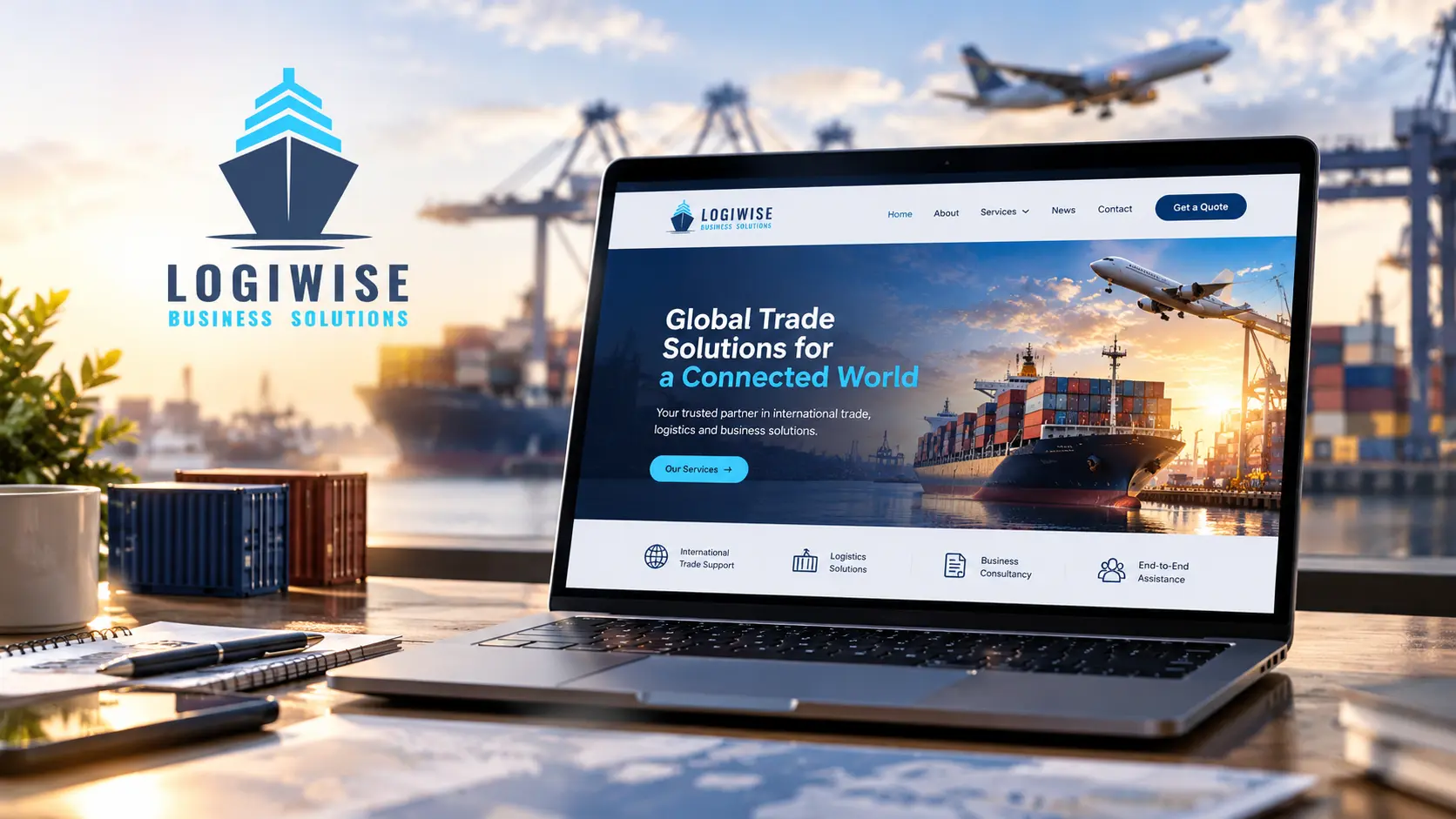
A good business website should make it easier to understand what a company does, who it helps and why somebody should trust it.
That sounds simple, but it becomes more challenging when the business itself covers a wide range of specialist services.
Logiwise Business Solutions works across global trade, logistics and supply-chain consulting. Its services include import-export documentation and trade support, factory setup and project cargo consultation, SME supply-chain advisory, sustainable supply-chain solutions, global network integration, risk mitigation, freight shipping and logistics consulting.
When we worked on the Logiwise digital presence, the goal was not to fill a website with technical logistics terminology. It was to turn that expertise into a business website that people could understand and navigate.
This is a look at the thinking behind the project and why clarity matters just as much as design.
The client
Logiwise Business Solutions is built around experience in international economics, global trade, supply chains and logistics.
The business positions itself between strategic advice and practical execution. A client may need help understanding customs and documentation, moving equipment for a factory project, improving an SME supply chain or navigating international freight and cross-border operations.
That creates an interesting website challenge.
There is a lot to communicate, but the visitor should not need industry knowledge just to work out where to start.
The website needed to explain the business quickly
When somebody lands on a business website for the first time, they usually make a decision very quickly about whether the company appears relevant to what they need.
For Logiwise, that meant establishing the main proposition early: expertise in global trade and logistics consulting, backed by practical support from planning through execution.
From there, the website could introduce the individual services without forcing everything into the first screen.
We wanted the journey to feel more like:
Who Logiwise is → what they can help with → why their experience matters → how to start a conversation.
That is a structure we use often for service businesses because it follows the questions a potential client naturally has.
Turning specialist services into understandable content
One of the easiest mistakes with a specialist business is writing the website entirely for people who already understand the industry.
That can produce technically accurate copy that is difficult for a potential customer to scan.
With Logiwise, the service structure needed to cover areas such as customs and trade documentation, project cargo, factory establishment, freight, supply-chain advisory and risk mitigation while still making sense to a business owner looking for help.
The solution was not to remove the specialist terminology. Those terms matter to the people searching for those services.
Instead, we paired clear service names with short explanations of the practical outcome.
For example, import-export documentation is not presented as a collection of acronyms. The website explains that Logiwise can help with customs, permits, HS codes and compliance requirements.
That approach is useful for customers and useful for search visibility because the page contains the terminology people use while still explaining what it means.
Building trust without overloading the page
Logistics and global trade are trust-heavy services.
A customer may be dealing with valuable goods, time-sensitive shipments, regulatory requirements or a major industrial project. A polished website alone is not enough to establish credibility.
The Logiwise site therefore combines its service information with experience, industry positioning, client feedback and a clear explanation of the people and expertise behind the business.
The current site highlights cross-border experience, an SME-focused approach, technology and strategy, industry relationships and testimonials from people working in international operations.
The aim is not to make the page shout "trust us" repeatedly. It is to give visitors enough real context to make their own judgement.
Making contact straightforward
A business website can look excellent and still fail if the next step is unclear.
For Logiwise, consultation is a natural conversion point. Someone looking at project cargo, import requirements or supply-chain advice will usually need a conversation before there is a fixed solution.
So the website makes consultation and enquiry actions visible rather than hiding contact information several pages deep.
This is a small design decision, but it matters. The website should help move a potential customer from research into a conversation without making them search for how to do it.
Designing for a business that can grow
Another part of business website development is avoiding a structure that only works for today's content.
Logiwise operates across several related areas, and those services can evolve as the business grows. The digital presence therefore needs room for stronger individual service content, future insights, case studies and additional search-focused landing pages without requiring the entire site to be redesigned each time.
That is particularly important for SEO.
A homepage can introduce a business, but it should not eventually be expected to rank for every service, location and customer problem the company addresses.
As the content strategy develops, individual services can be expanded into useful pages that answer more specific search intent while the main site remains easy to navigate.
The international side of the project
Techmendz is based in Brisbane, but web development does not need to stop at the Australian border.
Logiwise is a good example of working with a business whose market and operations are internationally focused.
The underlying website principles are the same: understand the business first, structure the information around the customer, keep the experience responsive and fast, and make future maintenance manageable.
The local details change. The fundamentals do not.
For a global-trade business, the website itself also needs to feel credible to somebody who may be viewing it from another country and assessing the company without ever having met the team in person.
That makes clear communication particularly important.
What we like about the finished direction
The strongest part of the Logiwise project is that the website now has a clear job.
It introduces the business as a global trade and logistics consultancy, explains the main areas where it can help, establishes the experience behind those services and gives potential clients a straightforward way to get in touch.
It does not try to turn logistics into something it is not. The industry is complex. The website simply makes that complexity easier to approach.
That is usually what a good service-business website should do.
What other businesses can take from this
There are a few principles from the Logiwise project that apply well beyond logistics.
Do not assume your customer understands your terminology. Use the terms people search for, but explain them in normal language.
Give the homepage a clear job. It should introduce the business and direct visitors rather than contain every piece of information the company has.
Show why people should trust you. Experience, real services, client feedback, projects and useful information are stronger than generic claims.
Make the next step obvious. If the goal is an enquiry or consultation, do not make the visitor hunt for it.
Build for the next stage. A website should make it possible to add stronger service pages, articles and client stories as the business grows.
A website should make a complicated business easier to understand
That is probably the simplest way to describe what we wanted to achieve with Logiwise.
A logistics and global-trade consultancy naturally deals with complicated work. Its website does not need to make that work feel more complicated.
At Techmendz, we build and support websites around the business behind them rather than starting with a template and forcing the company into it.
For Logiwise, that meant creating a clearer digital foundation for a specialist business operating across supply chains, freight, industrial projects and international trade.
You can see the finished website at Logiwise Business Solutions — logiwise.lk.
Client
Logiwise Business Solutions — Global trade, logistics and supply-chain consulting.
Project
Business website development and ongoing digital presence by Techmendz.
Source
- Logiwise Business Solutions — official website and current service information