
Is Your Business Website Ready for AI Search? SEO Is Changing in 2026
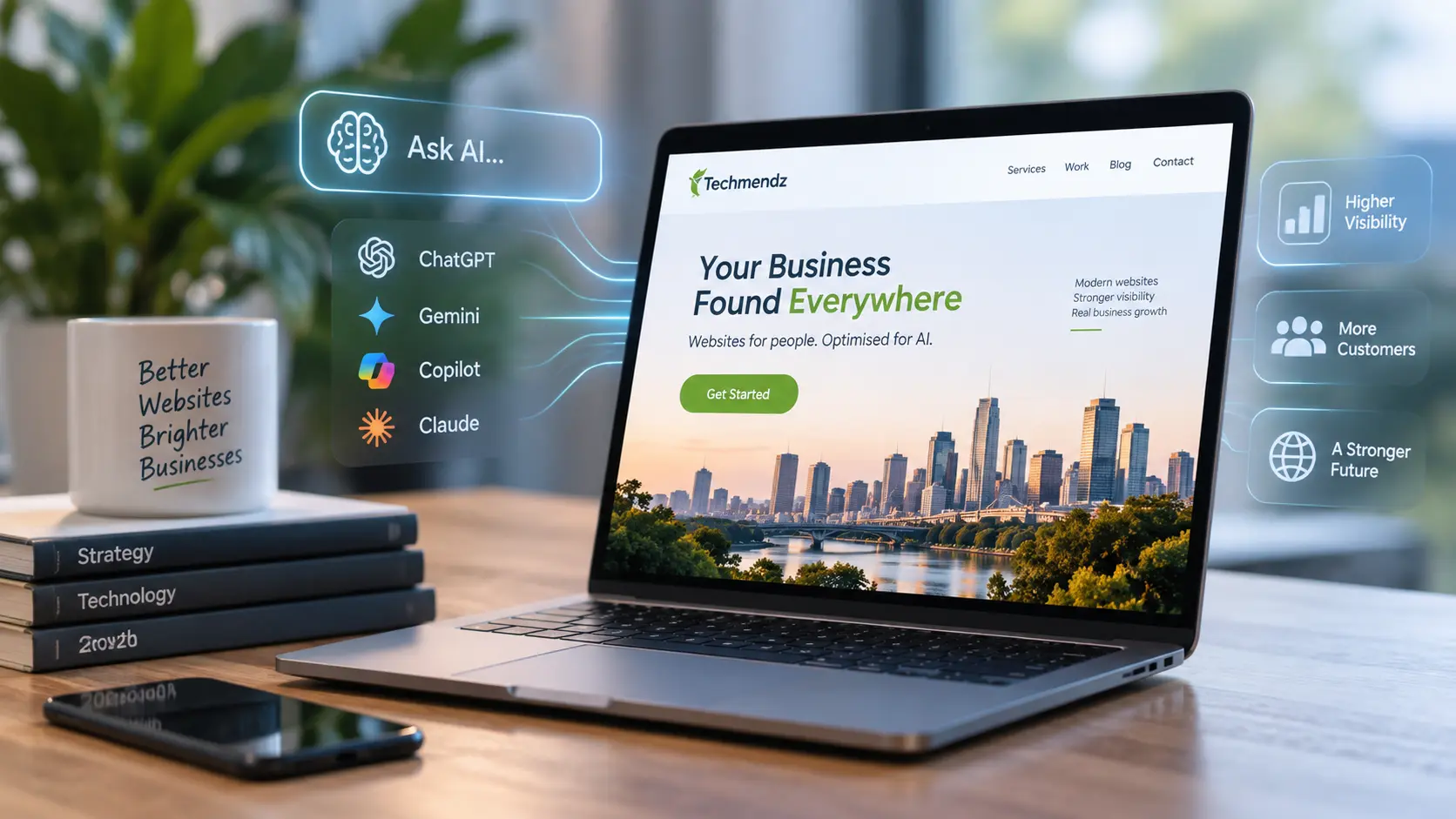
Image: Techmendz
Search is changing again, and this time it is bigger than another Google algorithm update.
People are still using Google, but the way they search is becoming more conversational. Google has AI Overviews and AI Mode, Microsoft is building AI answers into Bing and Copilot, and customers are increasingly comfortable asking an AI assistant a full question instead of typing three or four keywords into a search box.
For a small business, that creates an obvious question: does SEO still matter?
The short answer is yes. In fact, the fundamentals matter more than ever. What is changing is how your website may be discovered, understood and referenced.
AI search does not mean traditional SEO is dead
There is a lot of noise around terms such as AEO (Answer Engine Optimisation) and GEO (Generative Engine Optimisation). Some of it makes AI search sound like an entirely new system that needs a secret set of tricks.
That is not really what the search engines themselves are saying.
Google's current guidance is that its generative AI search features still build on the core Google Search index and ranking systems. A page generally needs to be crawlable, indexable and useful in normal search before it has a realistic opportunity to appear as a supporting source in an AI-generated result.
That means the boring-but-important work still counts:
- technically healthy pages;
- useful and original content;
- sensible page titles and descriptions;
- clear internal links;
- fast, mobile-friendly pages;
- accurate business information;
- good images where they add value; and
- structured data that accurately represents what visitors can actually see on the page.
So I would not recommend throwing away your existing SEO strategy because somebody is selling an “AI SEO” package.
I would improve the website itself first.
The bigger change is how people ask questions
Traditional SEO often focused heavily on a short query such as web developer brisbane.
That query still matters, but a potential customer can now ask something much more specific:
I run a small trade business in Brisbane. My website is five years old and gets enquiries but is slow on mobile. Should I rebuild it or improve the existing WordPress site?
That single question contains location, industry, a technical problem and purchase intent.
Modern search systems can break complicated questions into related searches and retrieve information from multiple sources before producing an answer. Google calls one of these techniques query fan-out.
For businesses, this makes genuinely useful content more valuable than pages that repeat the same keyword twenty times.
A good website should make it easy to understand what you do, who you help, where you operate and why your experience is useful.
Your content needs to be worth referencing
This is probably the biggest opportunity for small businesses.
The internet already has thousands of articles called things like “10 SEO Tips for Small Businesses”. Writing another generic version does not add much.
Instead, use what your business actually knows.
A Brisbane web developer could explain why a particular WooCommerce site became slow, what was changed and what happened afterwards. A builder could document common problems discovered during handover inspections. An accountant could explain a recurring bookkeeping mistake they see in Australian small businesses.
That first-hand knowledge is difficult to replace with generic content.
Google's 2026 guidance specifically puts emphasis on useful, unique, non-commodity content — content that brings something more than information that could have come from almost anywhere.
That is also a healthier content strategy for your customers. You are demonstrating expertise instead of simply telling people that you have it.
Make the important information easy to understand
You do not need to write for robots.
Write for the person trying to solve a problem, but organise the page properly.
Use descriptive headings. Answer the main question early. Break complicated subjects into logical sections. Use tables when a comparison is genuinely easier to understand as a table. Add useful images, examples and evidence when they improve the explanation.
This structure helps people scan a page and makes the underlying information clearer to search systems as well.
It is also worth reviewing old content. If three pages on your website all answer essentially the same question, combining them into one stronger resource can be better than maintaining several weak versions.
Local businesses should not forget the local part
For Techmendz clients, this is particularly important.
If you serve Brisbane, Ipswich, the Gold Coast or another defined area, your website should make that relationship clear naturally. That does not mean creating dozens of nearly identical suburb pages with the location name swapped out.
Instead, make location pages genuinely useful where there is a real reason for them to exist. Include the services available in that region, relevant examples, service-area information and content that reflects the customers you actually work with there.
Keep your Google Business Profile and other important business listings accurate too. AI-powered discovery does not make basic local-business information less important.
Technical SEO is still the foundation
Great content cannot do much if a crawler cannot reliably access it.
At a minimum, I would check:
- Important pages are indexable and not accidentally blocked by
robots.txtornoindex. - The site has a clean XML sitemap containing the URLs you actually want indexed.
- Canonical URLs are correct and duplicate versions of pages are controlled.
- Internal links make important services and articles easy to discover.
- The mobile experience is fast and usable.
- Structured data matches the content visible on the page.
- Images have meaningful alternative text where appropriate.
- Search Console and Bing Webmaster Tools are configured so you can see what the search engines are actually finding.
Bing also recommends keeping sitemap modification dates accurate and supports IndexNow for notifying participating search engines when URLs change.
None of this is particularly glamorous. It is also the work that prevents an otherwise excellent website from becoming invisible.
Can you actually measure AI search visibility?
This part is improving quickly.
Google introduced dedicated generative-AI performance reporting in Search Console during 2026, giving site owners more visibility into impressions and pages appearing in generative search experiences.
Bing Webmaster Tools has also introduced AI Performance reporting. It can show citations, cited pages and the kinds of grounding queries associated with content appearing in supported AI-generated answers.
For business owners, this means AI visibility is gradually becoming something we can evaluate with real first-party data rather than screenshots and guesswork.
The important word is gradually. These systems are still evolving, so I would not build an entire marketing strategy around one AI visibility metric.
Track enquiries, qualified leads and conversions alongside search visibility. Being mentioned by an AI system is nice. Getting the right customer is better.
Do you need an llms.txt file or special AI schema?
Not for Google Search.
Google says an llms.txt file is not required for Google Search and does not positively or negatively affect Google Search rankings or visibility. No special AI-specific schema markup is required to appear in AI Overviews or AI Mode. Google also cautions against chasing supposed AEO/GEO tricks instead of doing solid SEO and creating genuinely valuable content.
There can still be reasons to experiment with emerging standards, but they should not distract from the fundamentals.
If your website has poor service pages, duplicated copy, no useful content, broken metadata and a slow mobile experience, adding an AI-specific file is not going to magically solve the problem.
What I would do for a small business website in 2026
If I were reviewing a business website today, I would work in roughly this order:
First, fix the technical foundation. Make sure the site can be crawled, indexed and used comfortably on a phone.
Second, make every important service obvious. A visitor should quickly understand what the business does and what the next step is.
Third, build useful content around real customer questions. Use experience from actual projects, support requests and conversations rather than publishing articles just to hit a keyword quota.
Fourth, strengthen local relevance. Keep business information consistent and create location-specific content only where it provides genuine value.
Fifth, measure what happens. Use Search Console, Bing Webmaster Tools and your analytics or lead tracking to understand which pages are being discovered and which ones produce business.
Then keep improving.
The opportunity for smaller businesses
AI search can sound threatening because another layer now sits between a customer and the traditional list of search results.
But there is another way to look at it.
A smaller business with a technically solid website and genuinely useful first-hand content can provide exactly the kind of specific information these systems need when answering detailed questions. You do not need to become the biggest website on the internet. You need to be a credible and useful source for the problems your customers actually have.
That is a much better target than trying to trick an algorithm.
At Techmendz, we build, maintain and improve websites with that long-term approach in mind: solid development, practical SEO and content that helps real customers understand what a business can do for them.
If your website has not had a proper technical and SEO review for a while, 2026 is a very good time to find out whether it is ready for both traditional search and the increasingly AI-powered way people discover businesses.
Sources
- Google Search Central — Optimizing your website for generative AI features on Google Search
- Google Search Central — AI features and your website
- Google Search Central — Search Generative AI performance reports in Search Console
- Bing Webmaster Blog — Introducing AI Performance in Bing Webmaster Tools Public Preview
- Bing Webmaster Blog — Keeping Content Discoverable with Sitemaps in AI Powered Search